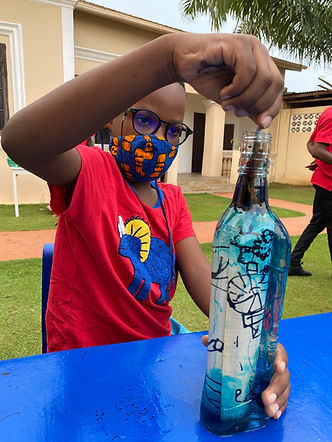
What is the “Petits Pinceaux” Workshop?
Located at the Fondation Zinsou Museum in Benin, the Petits Pinceaux (Little Paintbrushes) workshop is a free program open to children aged 5 to 13 on Wednesdays and Saturdays, as well as on other days for school visits.
It often represents a first introduction to visual arts education, which remains largely absent from the current school system in Benin.
Linked to the current exhibition or to the work of artists in residence, children are introduced to and practice drawing, painting, sculpture, photography, dance, and more.
Dedicated facilitators, supported by the mediation team, design new workshops every week—and they are always fully booked!
Artists also regularly lead sessions, and all artists in residence systematically take part in the Petits Pinceaux workshops. Craftspeople are sometimes involved as well, offering children a deeper understanding of traditional local know-how.
School Audiences
School groups, leisure centers, and various youth organizations are widely informed about the program and scheduled upon request. They take part in tailored workshops on Wednesdays, Thursdays, and Fridays, with two groups of twenty children attending each day.
The Petits Pinceaux workshop welcomes around 300 schoolchildren per month.
The Fondation Zinsou’s cultural facilitators also travel to schools and youth centers located within a twenty-minute walk of the museum—or use the Cultural Bus—to bring children to visit exhibitions and participate in hands-on artistic workshops.
The Cultural Bus enables access for school audiences. Since October 2009, thanks to the support of its patrons, the Fondation Zinsou has operated a bus that has transported visitors from more than 600 schools. In 2021, with the support of the ACP-EU Art in West Africa program led by the Korê Centre in Ségou and the Institut Français, the Cultural Bus was able to reach children in rural areas up to 100 km from the museum.
Accessibility and Free Admission
To ensure access for all, all Fondation Zinsou activities are free of charge. Access to the Petits Pinceaux workshops, transportation via the Cultural Bus, exhibitions, and guided tours is entirely free and open to everyone.
Why?
Because we firmly believe—now more than ever—that culture is a right and must never become a luxury.
Being a child in Benin should not—and must not—mean being excluded from museums, from the discovery of art, from exhibitions, or from encounters with creators.
Over the past 17 years, more than seven million young visitors have come to the Fondation Zinsou Museum and attended its exhibitions. This demonstrates a deep desire to discover contemporary creation, to experience forms of learning different from those offered at school, and to open up to the unique world of art.
Teachers and parents have embraced the museum far beyond expectations, transforming it into a key educational, recreational, and creative resource. Even a minimal entrance fee would constitute an insurmountable barrier and prevent access to the museum.
Artists and Petits Pinceaux
The Petits Pinceaux workshops are led daily by the Fondation Zinsou’s cultural facilitators, alongside regular contributions from invited artists throughout the year.
Whether photographers, sculptors, performers, painters, dancers, or illustrators, all take the time to meet the children and share the techniques and specificities of their practice.
Together with the facilitators, these artists teach children—each in their own way, but always with strong pedagogical care—how to express their emotions and ideas through art. They stimulate creativity and imagination through learning, experimentation with new materials, and exploration of new themes.
Whether in residence or featured in exhibitions, these artists design rich and engaging workshops that children would not miss for anything.
Over the years, Petits Pinceaux has welcomed artists such as Chloé Quenum, Schneider Léon Hilaire, Baudouin Mouanda, Marie Bovo, Louis Oke Agbo, Aston, Pauline Guerrier, Karine Maincent, Hector Sonon, Bruce Clarke, Jean-Dominique Burton, Pierrick Chabi, Ishola Akpo, Ivan Argote, Jérémy Demester, Kifouli Dossou, Salia Sanou (choreographer), Patrick Ruffino (musician), Loïc Dablé (chef), among others.
Petits Pinceaux: A Tool for Development and Openness to the World
First and foremost, the Petits Pinceaux workshops are a powerful tool for social connection. They enable children—often far removed from cultural experiences for economic, geographic, or social reasons—to discover contemporary art, learn artistic techniques, practice them, and develop habits of visiting a major cultural institution: the museum.
They also foster independence: children from the neighborhood learn to come to the museum on their own, developing new habits and passing them on within their communities. The artworks they create and take home become sources of pride and self-confidence.
For school groups, the workshops create connections between the academic curriculum and artistic practice, embedding these experiences within a broader, more universal cultural framework.
The workshops also bring together children of different ages and diverse social, economic, and geographic backgrounds. They collaborate, support one another, create individual and collective works, and build relationships. This also strengthens ties with museum staff, who become trusted figures and transmitters of knowledge within the community.
The learning environment differs from that of school: it is based on a gentle pedagogy that encourages learning through play and creativity. Children encounter new ways of thinking, creating, and expressing themselves, as well as artworks and perspectives from artists around the world. This fosters an international outlook and helps them envision the wider world in a positive way.
By combining artistic practice with visits to contemporary art exhibitions, the Petits Pinceaux workshops allow children to engage with diverse forms of expression within their society, develop new spatial and temporal awareness, and gain a broader perspective on their environment—and beyond.